
Main Page
Last Page

Historic Railcars

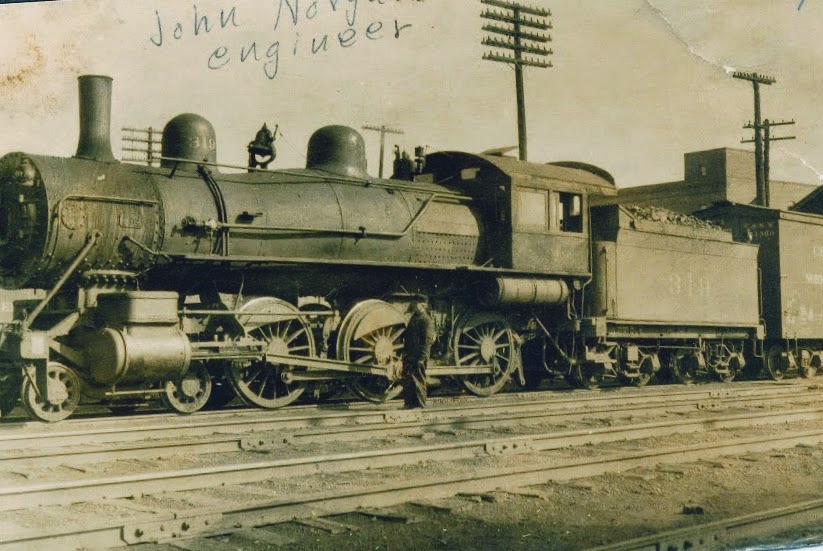
Chicago, Burlington, & Quincy Railroad locomotive 915 was originally built as a coal-burner in 1902 bat the Burlington shops in Havelock, Nebraska.  The locomotive was later modified to burn oil.

CB&Q 915
This Chicago Burlington & Quincy 4-6-0 locomotive was built in 1902 at the Burlington shops in Havelock (Lincoln, NE) and was originally a coal burning engine.  This locomotive was brought from Dodge Park along with the Omaha Club car and the caboose.
The locomotive was later modified to burn oil.

Union Pacific locomotive 814 was one of the first 20 4-5-4 locomotives purchased by the Union Pacific from the American Locomotive Company in 1937.

UP 814
This 4-8-4 locomotive was one of 20 Northern locomotives purchased in 1937 from the American Locomotive Company by the Union Pacific.  These were the standard workhorse engines used by the UP to haul freight and passenger cars. They lasted through the entire period of steam.  This engine was converted from coal to oil and had the tender replaced at that time.

Communication from Caboose to Engine

Before the use of radio, an Engineer could only speak to the crew in the caboose with “whistle talk” or blowing the locomotive’s horn in a code. If they needed to speak face-to-face, they would have to stop the train and meet halfway along the tracks to exchange information.

Plymouth 5700
photo coming soon!

This locomotive weighs 45 tons and was built in 1953 by the Plymouth Locomotive works of Plymouth, Ohio.  It was donated to the Historical Society in May, 2007, by the MidAmerican Energy Company where it was used to move train carloads of coal at the power plant.  When the new unit was completed in the 1970’s, it had a new coal handling system that made the locomotive largely obsolete.  Recent expansion of the Energy Center created the need for more space and led to its donation to the Historical Society.

Chicago, Burlington, & Quincy Railroad locomotive 915 was originally built as a coal-burner in 1902 bat the Burlington shops in Havelock, Nebraska.  The locomotive was later modified to burn oil.
 
Rock Island Railroad 17130 is a "bay window" caboose restored to its original 1967 appearance.  The caboose came to Council Bluffs in 1980 from Grand Island, Nebraska after it was purchased by the Union Pacific from the bankrupt Rock Island.

ROCK ISLAND 17130
This Rock Island Caboose came from Grand Island, NE from the Union Pacific. The Union Pacific acquired the car after the Rock Island discontinued its service in 1980. It was built in 1967, and has been restored and painted in its original colors. This caboose is a newer model and was heated by oil and had fresh running water and a toilet that flushed onto the tracks.  This Rock Island Caboose is a “bay-window” style caboose. The caboose is like a home and office on wheels for the Conductor and the Brakeman. They would sit in the seats on either side of the car and watch the train for signs of problems. Some problems they might see are: smoke from a wheel indicating a “hot box”, some freight the train is carrying hanging over the side of a car, or if they saw dirt and dust flying it meant they had a car off the rails.


“Little House on Wheels”
The caboose was the home on wheels for the train crew. The long benches on the side were both lockers and sleeping accommodations. At the time when this caboose was in service, a single crew would have been assigned to it. The Conductor was able to add “homey” touches like curtains, ovens and dishes to make lives easier on the road.

“A typical caboose would carry one or more hams, a huge side of bacon, sacks of flour and sugar, a bushel of potatoes, some onions, ample coffee and canned goods. Four or five large wheat sacks filled with coal would be lashed to the running board and there would be a triple supply of kerosene.” From the Railroad Caboose by William Knapke and Freeman Hubbard.

The Conductor had to be mindful of the possibility of being stranded away from amenities by severe winter weather or accidents. They never wanted to be “caught short” when it came to supplies.

Did you know…?
that the word caboose was originally a nautical term referring to a small house on the deck of a ship where cooking was done. The word has also been likened to the Dutch word “kabuis”, the Danish “kabys” and the German word “kabuse”, each meaning a little room or hut. Regardless of its origin, the caboose was the home and galley to its crew. It was where they slept, ate and did their paperwork. It truly was a “little house” on wheels.

  Chicago, Burlington, & Quincy 13855 is a wood-sided "waycar," as the CB&Q called its cabooses.

CB&Q 13855
This Burlington Caboose, #13855, is a “cupola” [cữpolặ] style caboose. The caboose is like a home and office on wheels for the Conductor and the Brakeman. They would sit in the seats up in the cupola, on either side of the car and watch the train for signs of problems. Some problems they were watching out for are: smoke from a wheel indicating a “hot box”, the freight the train is carrying hanging over the side of a car, or if they saw dirt and dust flying it meant they had a car off the rails!  This Caboose was heated by a wood stove, but it did have running water and a toilet that flushed onto the tracks.  Chicago, Burlington, & Quincy #13855 is a wood-sided "waycar," as the CB&Q called its cabooses. 

Did you know…?
that the origin of the caboose cupola is credited to T.B. Watson, a Chicago and Northwestern freight conductor running between Cedar Rapids and Clinton, Iowa! “One bright summer’s day in 1863, about the time that the battle of Gettysburg was being fought in Pennsylvania, Watson’s flat-topped caboose was assigned temporarily to a work-train and he used an old boxcar instead. According to the story, this car had a large hole in the roof and the whimsical Watson piled boxes on the floor and sat atop one in such a way that his head and shoulders protruded above the roof. This odd position gave him a fine view of his train and the Iowa prairie… Upon arrival at Clinton, he sought out the master mechanic, told him about the trip, and then suggested that “crow’s nests” be included in the two new waycars (or cabooses) then being built at the Northwestern shops there. The official agreed, the cars were constructed that way…” From the Railroad Caboose by William Knapke and Freeman Hubbard.

Even though the forward thinking Watson had his cupola style cabooses made, it was some time before they became mainstream in the railroading industry. Even in 1869, at the joining of the Transcontinental Railroad, neither Union Pacific nor Central Pacific had cupola style cabooses. It is interesting that most of the lore and songs about cabooses refer to the cupola style.

The CB & Q Railroad's Omaha Club Car shows the elegance once available to those traveling by rail.  The years have taken their toll, however, and the restoration of the Omaha Club is just one of the many ongoing projects the historical society is involved with.
CB&Q  OMAHA CLUB CAR
This car is an observation/lounge car. It ran on Chicago, Burlington and Quincy Railroad (CB & Q) between Chicago and Lincoln during the 1930’s and 1940’s. The carpeting, furniture and lamp shades are original to the car. Some items have needed minor repair and yet other items have been added to assist in creating the “mood” of the 1940’s. This car was used as a Lounge car; purely for smoking, relaxing or playing cards and getting a light meal. The passengers using this car would have had assigned seats elsewhere in the train. This changed due to a fuel shortage in World War II. At that time, the railroad was not allowed to use the car as only a “social” car. Tickets were then sold with numbers that corresponded to the numbers above the chairs, giving passengers assigned seating in this car as well. This allowed the railroad to offer services to more people on the same train. The small buttons above the seats were used to call the Porter for service.

CB&Q OMAHA CLUB CAR
The CB & Q Railroad's Omaha Club Car shows the elegance once available to those traveling by rail. The years have taken their toll, however, and the restoration of the Omaha Club is just one of the many ongoing projects the historical society is involved with.
This car was brought from Dodge Park along with the locomotive and the caboose.
A Caboose by any other name….
Some other names for the caboose are:  “Crummy” “Waycar” “Anchor” “Brainbox” “Hack” “Palace” “Parlor” “Monkey Cage” ... just to name a few!
Union Pacific Railway Post Office 5908.  One of the more unique railcars on display at the Railswest Railroad Museum is a Railrway Post Office car.  This 85 foot long, stainless steel RPO was one of nine RPO's purchased by the Union Pacific in 1963.  An RPO was typically staffed by 8 to 13 men who sorted the mail in transit across the country. This car was used between Chicago and Ogden, Utah and crews were changed at Ogden, Chicago, Cheyenne, or Council Bluffs which was home to one of the country's largest mail terminals.  In 1920, a mail car was robbed in Council Bluffs of over $3.5 million in cash and securities in what was the biggest robbery of its type at that time.  RPO 5908 remained in service until 1967 when the Post Office ended its contracts with the railroads to carry the nation's mail.
UP 5908

Union Pacific Railway Post Office 5908.  One of the more unique railcars on display at the Railswest Railroad Museum is a Railrway Post Office car.  This 85 foot long, stainless steel RPO was one of nine RPO's purchased by the Union Pacific in 1963.  An RPO was typically staffed by 8 to 13 men who sorted the mail in transit across the country. This car was used between Chicago and Ogden, Utah and crews were changed at Ogden, Chicago, Cheyenne, or Council Bluffs which was home to one of the country's largest mail terminals.  In 1920, a mail car was robbed in Council Bluffs of over $3.5 million in cash and securities in what was the biggest robbery of its type at that time.  RPO 5908 remained in service until 1967 when the Post Office ended its contracts with the railroads to carry the nation's mail.
UP 5908
Union Pacific Railway Post Office 5908. One of the more unique railcars on display at the Railswest Railroad Museum is a Railrway Post Office car. This 85 foot long, stainless steel RPO was one of nine RPO's purchased by the Union Pacific in 1963. An RPO was typically staffed by 8 to 13 men who sorted the mail in transit across the country. This car was used between Chicago and Ogden, Utah and crews were changed at Ogden, Chicago, Cheyenne, or Council Bluffs which was home to one of the country's largest mail terminals. In 1920, a mail car was robbed in Council Bluffs of over $3.5 million in cash and securities in what was the biggest robbery of its type at that time. RPO 5908 remained in service until 1967 when the Post Office ended its contracts with the railroads to carry the nation's mail.


UP 5908


Text for the above photos was provided by Outreach Coordinator Patricia LaBounty and Historical Society board member Ryan Roenfeld.
These historic rail cars are on display at the RailsWest Museum.


Main Page ] Last Page ]

The Historical Society of Pottawattamie County, Iowa was founded in 1934 and is a 501 (c) 3 non-profit organization dedicated to kindling and keeping alive an active interest in state and local history.  Contributions and inquiries should be directed to the Society  at P.O. Box 2, Council Bluffs, Iowa 51502-0002.  For additional information, phone 712-323-2509 or e-mail us here.

This site is optimized for Microsoft Internet Explorer, and not all features may work with certain other browsers.  Please let us know about site issues you encounter.

Copyright © The Historical Society of Pottawattamie County, Iowa