
The Council Bluffs Implement District
by Ryan Roenfeld

The neighborhood south of the Haymarket along South 4th, South Main, and South 6th Streets from 9th to 16th Avenues was once the bustling center of an all but forgotten era when Council Bluffs was one of America’s major shipping points to the farmers of the West. Only a few scattered remnants remain from the time when the city claimed to be the country’s second largest distribution point for agricultural implements with business, in today’s dollars, at well over 250 million annually. The implement business remained profitable into the first decades of the 20th century as a wealth of smaller manufacturers and businesses opened nearby, particularly those related to agriculture and, ultimately, food production. As the nature of the business changed, a handful of manufacturers produced their own implements in Council Bluffs as most implement dealers left the fire plagued area and moved further north on South Main to a much reduced “implement row” near downtown. During its peak, the implement trade in Council Bluffs offers a reflection on the growing mechanization of agriculture and the incredible variety of implements available to farmers from a wide variety of American manufacturers whose products were shipped to town via rail and then on to stores and farms across the Great Plains.

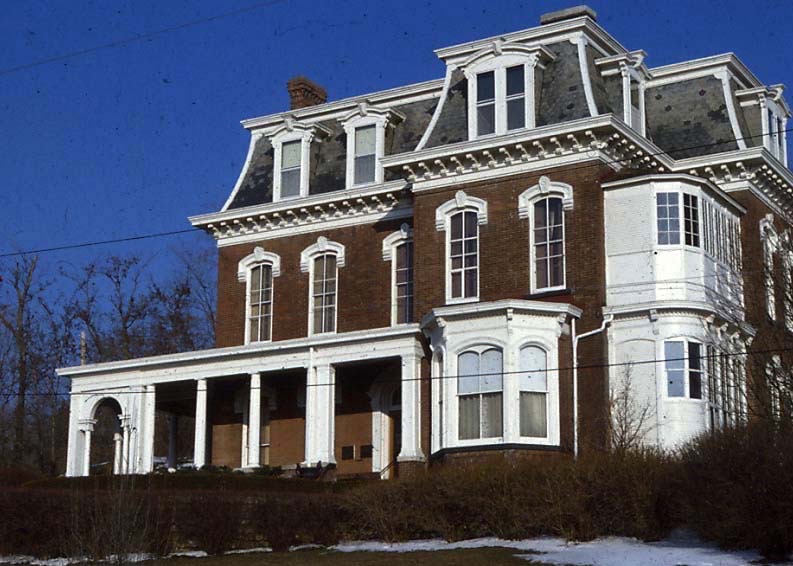
The success of the implement trade at Council Bluffs was deeply intertwined with the tangle of rail yards that appeared south of downtown during the 1870‘s. At the same time, the economic interdependence between the railroads and the Implement District is evident both during the railroads dominance in the early 1900’s and the industry’s late 20th century decline. Before the Council Bluffs & St. Joe Railroad was completed in May 1868 the neighborhoods south of the Haymarket straddling Williams Addition and Riddle’s Subdivision were primarily residential, almost rural in character. The Italianate home at 327 9th Avenue and particularly the two-story brick residence at 612 South 4th Street remain among the handful of examples from that era. Changes came rapidly after 1866 when the city first granted the CB & St. Joe rights to build a single-track line all along Casady (now South 12th) Street with a single-track line on South Main to Oak Street (now 9th Avenue) “near the foundry“. The foundry was the long-established Council Bluffs Ironworks housed in a three-story building that dominated the northwest corner of South Main at Pine Street, now 10th Avenue.

Many more changes followed the completion of the Rock Island into Council Bluffs in May 1869. The Rock Island route down Mosquito Creek had been surveyed by Peter Dey and Grenville Dodge back in 1853 for the Mississippi & Missouri River Railroad. In 1857, shortly before the M & MR went bankrupt, the city granted the railroad right of way for a “double track…the full length of and through Railroad street….across Cherry Street (now 15th Avenue), south from its intersection with Farnam“, now 11th Avenue. The Burlington was completed across Iowa a few months after the Rock Island with trains running north into Council Bluffs via tracks of the old CB & St. Joe. The Burlington was granted “exclusive use and occupancy” of Durant, Commercial, and Walnut Streets (12th - 14th Avenues) between South Main and Bancroft (South 4th ) Streets with extensive right of way through the Implement District and a passenger depot at Bancroft and Durant. By 1871 three westbound and three eastbound trains pulled out of the Burlington depot daily, including the #1 Pacific Express and #2 Atlantic Express. To help encourage further economic development, a Manufacturer’s Association was organized in the early 1870’s with Grenville Dodge as its first president.

By that time the old CB & St. Joe had become part of the Kansas City, Council Bluffs, and St. Joseph Railroad with a depot located at Bancroft Street and Missouri (16th) Avenue. In 1871 the “Kansas City” promoted itself as the “great Through Southern & Eastern Passenger Line” with two “magnificent Pullman’s Palace Sleeping Cars” leaving Council Bluffs daily on the “4:30 afternoon Express“ bound for Quincy or St. Louis. In 1872 the Kansas City was granted right of way to the UP Transfer on Commercial Street west from Baldwin (South 8th ) Street. To serve the new depots, John Baldwin’s Broadway Street Railway expanded its line of horse-drawn hacks south on Pearl and Main past the Burlington depot down to the Kansas City depot. The rail yards of the Kansas City were down Center (South 6th) Street between Missouri Avenue and Cochran Street (16th and 18th Avenues) and were the epicenter of the 1877 railroad strike in Council Bluffs where armed strikers forced engineers out of their locomotives and patrolled the yards with guns and torches to ensure that no train would get through. At that time the Rock Island depot was situated a few blocks west at Nebraska and Durant Streets (now South 10th and 12th Avenue) with the Rock Island yards along modern 12th Avenue between South 9th and South 14th Streets.

Another early-day feature in the Implement District was the three-story Second Ward, or Center Street, School once located at present day South 6th and 13th Avenue. At the same time, farm implements broken in transit, obsolete, burned into twisted hulks, or that just couldn’t be sold also brought about the rise of several salvage and junk companies. The area also became notable for its lumber yards as well as the nearby Council Bluffs Gas Works at South 7th and 11th Avenue. At same time, the District also emerged as an important shipping point for coal which heated and powered almost everything during the late 19th and early 20th centuries. The local abundance kept prices much lower than elsewhere and even confounded financier Jay Gould’s mid-1870’s effort to establish a coal monopoly on the Union Pacific line from Council Bluffs west to Ogden, Utah. The lower prices also led to a successful 1886 lawsuit by Iowa Governor Larrabee against the Burlington for shipping coal at $1.80 a ton to the Iowa Institution for Feeble-Minded Children at Glenwood but only charging $1.25 per ton shipped 30 miles further to Council Bluffs.

The farm implement trade made several businessmen among the wealthiest and most prominent residents in town. Perhaps the most notable was Eli Shugart, a native Pennsylvanian who came to Council Bluffs 1868. He was elected to the Council Bluffs city council three years later and was one of the principal investors in the new Council Bluffs Agricultural Works. The CB Ag Works was originally located on the east side of North Main before it was moved near the Rock Island depot. Shugart’s business partners included Fred Weiss and George Lininger whose Omaha home at 18th and Davenport Streets housed the area’s first art museum. The CB Ag Works produced cultivators, corn-planters, broadcast seeders, and sowers. The partnership was dissolved in 1875 and Shugart was defeated by John Keatley in the surprising “nonpartisan” 1876 mayoral election. The CB Ag Works was again relocated and then totally destroyed in a late 1870’s fire. Shugart remained in the wholesale business with his partners until 1880 when he established the Shugart Implement Company and also delved into the wholesale hardware business and served several terms on the City Council. Amidst his growing wealth and prominence, Shugart and his family resided in the two-story brick Italianate home originally situated cater-corner to Bayliss Park at South 6th and 1st Avenue.

Another local businessman who profited from the implement trade was Millard Filmore Rohrer, a Maryland native who came to Council Bluffs in 1871 as a salesman for a Kansas wheat company. Instead of accepting a transfer to Texas, Rohrer quit his job and remained in town to clerk at the Biggs House Hotel. Rohrer went on to work in a bookstore, was appointed deputy sheriff, worked as an agent for the Burlington Railroad, and fortuitously went into the fire insurance business with Thomas Bowman in 1875. From 1881-85 the two partners also operated the implement firm of Bowman, Rohrer & Company and Bowman was elected Mayor in 1882 and 1883. Rohrer remained an insurance agent and land speculator and was appointed Mayor in December 1887. In March 1888 he was elected Mayor as a Democrat and embarked on a series of improvements during his 26 _ month administration by paving eight miles of city streets with cedar blocks and helping establish the Council Bluffs Chautauqua Grounds. Rohrer also attracted some notoriety after suggesting the city license saloons in spite of Iowa’s prohibition laws which prompted the Malvern Leader to question “Why don’t the Mayor and the City Council take advantage of the darkness of a moonless night and go out and rob a bank of the money necessary to carry on the city government?” In Rohrer’s final message to the city council in March 1890 he also suggested the taxation potential of “Cut-off Island” which is now the municipality of Carter Lake. Rohrer, who lived with his wife Sarah at 239 Vine, was also instrumental in the development of Rohrer Park neighborhood, the remnants of which were donated by his widow to become the city’s Lincoln Memorial Park.

The early 1880’s were years of tremendous growth in the Implement District as farmers had spread west across Nebraska, Kansas, and into the Dakotas. In 1881, Keystone Manufacturing opened a three-story brick warehouse at 1501-1507 South Main as the outlet for their factory at Rock Falls, Illinois where their well-known Keystone Combined Corn Husker & Fodder Shredder, Victor Disc Harrows, and Keystone Hay Loaders were manufactured. The Deere, Wells & Company first opened in Council Bluffs in November 1881 as wholesale dealers in agricultural implement, wagons, and vehicles. The Council Bluffs operation joined the handful of John Deere partnership houses in San Francisco, Kansas City, Minneapolis, and St. Louis. Manager (and one-third owner) of the local branch was Lucius Wells in partnership with John Deere & Company and the Moline Wagon Works. Wells was born in Illinois and went to work for Deere & Company after he graduated from Lombard University in Galesburg. The Council Bluffs office had 25 employees by the early 1880’s and Wells, who lived on Oakland Avenue, was elected to the Council Bluffs City Council as Alderman-at-large in 1887. The implement business also brought Edgar Merriam to Council Bluffs in 1882. Born in Connecticut, Merriam came to southwest Iowa to join the growing wholesale trade in the Implement District as secretary for David Bradley & Company. David Bradley‘s factory complex was in Chicago with their large wholesale outlet in Council Bluffs housed in a four-story brick building that remained a fixture on west side of South Main just south of 11th Avenue for the next century.

Two additional rail lines were built into Council Bluffs and the Implement District in the early 1880’s. In 1879, the city laid out South Avenue and granted the proposed “Council Bluffs & St. Louis Railroad” right of way to Farnam Street (now 11th Avenue) and west to the U.P. Transfer. Soon to be the Wabash, the CB & St. Louis was completed by 1880 with yards further south and tracks running into the Implement District and the railroad’s freight depot on 12th Avenue. Likewise, the Chicago, St. Paul, & Milwaukee Railroad was granted land in 1881 for “depots and railway grounds” on 13th Avenue between 6th and 7th Streets and completed its second trans-Iowa line into Council Bluffs by 1882. The Milwaukee kept a freight house at 1300 South 6th with yards stretching from 20th to South Avenues.

Although most Council Bluffs streets would remain dirt for decades, the growing businesses, depots, and heavy traffic through the Implement District during the mid-1880’s led to the paving of South Main with granite blocks from West Broadway all the way down to 16th Avenue. Implement houses included Deere, Wells & Co on the east side of South Main at 14th Avenue, Shugart, Waite, & Weiss Implements on both sides of South Main at 15th Avenue, and Keystone Manufacturing on the southeast corner of South Main and 15th Avenue. The Burlington freight house was on the east side of South Main at 13th Avenue with Marseilles Manufacturing and Sandwich Manufacturing situated west across the street. Marseilles and Sandwich were the wholesale houses for factory operations at, respectively, Marseilles and Sandwich, Illinois. Marseilles manufactured a variety of farm implements, including their popular Cyclone Self-Feeding Corn Shellers, Universal Feed Grinders, and Steel Queen, Princess, Splendid, and Adams windmills . Sandwich also offered a wide line of implements, including windmills, pumps, and planters along with Climax Cultivators, Sandwich Self-Feeding Corn Shellers, Dean Patent Ear Corn Cutters, and O.K. Independent Feed Grinders. The Council Bluffs Ironworks was still situated on the northwest corner of South Main and 10th Avenue with an expansive foundry south across the street. The Winterlich Foundry was nearby on the west side of South 6th at 11th Avenue and the two-story Lowers House Hotel was open for business at 1019-1021 South Main. In 1886, Council Bluffs Fire Station 1 opened up the street on South Main and 8th Avenue and its proximity to the Implement District kept it a busy place until it finally closed in 1960.

The Implement District was first illuminated at night in 1887 when one of the city’s seven 150 foot tall “light towers” was placed on South 6th at 12th Avenue. That same year the Union Pacific was granted permission build track and “construct and maintain” a freight depot on 10th Avenue between South 6th and South 9th Streets. The UP later gained right of way on 10th Avenue between South 4th and South 6th Streets and across 11th through 13th Avenues. The Council Bluffs Lumber Company was also first incorporated in 1887 at 900 South Main. Hotels in the Implement District by the late 1880’s included the Atlantic House at 901 South Main, the renamed Mergen Hotel at 1019-1021 South Main, the Kelley House at 1212 South Main, the Kansas City House at 1509 South Main and Mrs. Durgin’s Emmett House Hotel at 1521 South 6th Street.

Both the Emmett and Kansas City hotels were down near the Kansas City railroad yards which once again proved a flashpoint of labor trouble during the 1888 strike by the Brotherhood of Locomotive Engineers against the Burlington. The strikers rented T.L. Smith’s Hall at nearby South 7th and 16th Avenue as headquarters and found strong support from the Knights of Labor. However, the refusal of Milwaukee engineers and firemen to “go out” and join the boycott of the Burlington led to the strike’s failure by the end of the year.

The population of Council Bluffs was almost 21,500 during the early 1890’s when the Hawkeye Mills stood at South 6th and 11th Avenue, the Trinity Methodist Church was on the southwest corner of South 4th and 9th Avenue, and five saloons and four groceries were open on the east side of South Main between 9th and 11th Avenues. David Bradley & Company was on the west side of the 1100 block of South Main while the McFarlan Carriage Works on the northeast corner of South 6th and 12th Avenue was the outlet for the company’s factory at Connersville, Indiana. Outside the Implement District, Chicago’s Plano Manufacturing had an implement warehouse at West Broadway and 32nd Street a block south of A.C. Kellar’s Horse Collar Company, McConnell & Green’s Agricultural Works produced a line of implements for a few years down on South Avenue, and the Council Bluffs Canning Factory and Ogden Iron Works were on the east side of South 10th at 11th Avenue. At the same time Keystone and other wholesale implement houses were still clustered on South Main and 15th Avenue near the Rock Island depot and also lined the east side of South Main south of the Burlington freight house at 13th Avenue. In 1891, westbound traffic on the Burlington included daily freight trains #75 and 79; passenger trains # 11, 5, and 3; and the #7 Fast Mail. Daily eastbound Burlington trains (which first went south to Pacific Junction) included passenger trains #4, 6, and 12; the #8 Fast Mail, and the #80 freight. Implement warehouses had also appeared around South 6th and 13th Avenue near the Milwaukee freight house and also around the Wabash freight house on 12th Avenue east of South 4th Street. Deere & Mansur also joined with Deere, Wells & Company in Council Bluffs in 1891 as the business had grown into “the leading and largest house of its kind in the Northwest”.

Deere, Wells & Company’s local dominance was contested after 1892 when Eli Shugart was named president of the newly organized Pioneer Implement Company of Council Bluffs. Spurred by the “necessity of the general agency or jobbing house on the Missouri”, Pioneer Implement was headquartered in the imposing four-story brick building with its array of Romanesque windows that continues to dominate South Main at 10th Avenue. In addition to implements, Pioneer also offered a wide line of horse-drawn vehicles, including phaetons, surreys, the traditional one-horse sleigh ‘cutter’, Racine-Jackson spring buggies, and Bennett & Frantz buggies. Shugart found continued success in the wholesale implement and hardware business, helped organize the Citizens State Bank, and eventually retired to his country estate “Edgewood” just east of Council Bluffs. His Italianate home on South 6th was moved back to the alley to make way for the architecturally unique Shugart Apartments still situated on the corner of South 6th and 1st Avenue.

In 1892, St. Paul’s German Lutheran Church was constructed at 627 7th Avenue and B.A. Wyman opened the Council Bluffs & Omaha Transfer Company at 1005 South 4th in Council Bluffs and 412 South 11th Street in Omaha. The C.B. & Omaha Transfer employed “fifteen modern drays constantly moving all kinds of goods with prompt dispatch…” English Swedenborgians Edwin and Sarah Children also first arrived in Council Bluffs in 1892 and E. Children’s Sons Manufacturing soon opened south of the Implement District. Frank R. Children was manager of the factory on South Avenue which employed 80 workers to produce cultivators, sweep rakes, hay stackers, and feed mills. Another large dealer outside the Implement District was Henry H. Van Brunt with 65 styles of “carriages, buggies, coupes, surreys phaetons, wagons and bicycles” available at his store at 12-22 South 4th Street with extensive warehouses at 10th Street and West Broadway near the Chicago & Northwestern depot. Van Brunt also housed the local offices for the Rock Island Plow, J. Thompson & Sons, George W. Brown & Co., F.B. Tait & Co., and Haworth & Sons. Van Brunt’s financial success also led to his election on the city council and a mansion at 203 Bluff Street built in 1890. Likewise, the Keys Brothers on South 28th Street manufactured carriages and wagons well west of the Implement District with Rassmussen’s carriage and wagon factory at 111 West Broadway and Schultz & Hill’s well-known wagon works long located on the southeast corner of South 4th and 5th Avenue.

Down in the Implement District, a new brick passenger depot was constructed by the Burlington in 1893 and the four-story Union Transfer Company opened at 1308 South Main as a “general storage and forwarding business” that distributed products from 30 different manufacturers during peak years. E.P. Searle’s Monarch Manufacturing first opened in 1895 to produce five brands of axle grease. That same year in December, another destructive fire swept South Main and flames destroyed the Combination Fence Works, the expansive Deere, Wells & Company warehouses on the southeast corner of South Main and 14th Avenue, and the Empkie-Shugart wholesale hardware warehouse just to the south. Heavy south winds spread burning embers across town and ignited the Pioneer Saloon, the St. Joe barn at 623 South Main, and the Rex Lumber yards at 900 South Main. Although the smaller fires were extinguished Andrew McMillen would write decades later that fire ultimately proved the great bane of “implement row” and noted that “Every implement firm doing business in Omaha today started in Council Bluffs.

By the late 1890’s the U.P. freight depot that still stands on South 6th had been built and Pioneer Implement’s dominating presence at South Main and 10th Avenue was joined by the equally commanding McCormick Harvesting Building on South 6th and 10th Avenue. In 1895, Cyrus’s youngest son Harold F. McCormick was sent to southwest Iowa as General Agent of the company’s new Council Bluffs operation and was accompanied by his first wife Edith, the youngest daughter of John D. and Laura Rockefeller. The McCormicks rented the Donald Macrae home at South 8th and 5th Avenue during their stay which led to several visits to town from Edith’s legendary parents. On Sunday mornings the Rockefellers attended the First Baptist Church at on South 6th and 1st Avenue and then joined the McCormicks for evening services over at the Presbyterian Church. Supposedly, the tycoon of Standard Oil turned down the Baptists request for a new organ and instead bought the church a new roof. The McCormicks left Council Bluffs and returned to Chicago in 1899. Reputedly on the advice of Don Macrae Jr, they took a young clerk named Alexander Legge back to Chicago and Legge would eventually succeed Harold McCormick as the head of International-Harvester.

Three blocks from McCormick’s on the southwest corner of South Main and 13th Avenue stood the three-story warehouse of Peru Plow & Implement which opened its Council Bluffs outlet in 1895 to distribute implements produced in LaSalle County, Illinois. Down the street, Dr. J.B. Patterson was manager of Keystone Manufacturing’s Council Bluffs office at 1501-1507 South Main. “Honest John” Clausen‘s Transfer House at 1218 South 6th was also among the busiest implement houses in town. Clausen was a German immigrant who came to Council Bluffs in 1856 and opened the One-Horse Grocery in a log cabin at West Broadway and Park Avenue ten years later. He built his Pierce Street home on the site of the old Jesuit mission to the Potawatomi and was first elected City Treasurer in 1876. By 1898 Clausen’s housed the Council Bluffs offices for Gale Manufacturing of Albion, Michigan specializing in Daisy High Lift Gang & Sulky Plows and Dixie and Empress Cultivators and also the South Bend Chilled Plow Company which produced “planters, stalk cutters, harrows, garden tools, and walking plows of all kinds” in South Bend, Indiana. The Wilson Moline Buggy Company of Illinois also kept an office at Clausen’s to sell their “high grade carriages, surreys, buggies, road wagons and spring wagons”.

South of 12th Avenue near the Milwaukee freight house was the warehouse for Fuller & Johnson which manufactured a variety of implements in Madison, Wisconsin, including their well known corn planters. The Combination Fence Factory was on 12th Avenue at South 4th Street and the Wabash freight depot was a half-block east on the north side of 12th Avenue with Jennings Coal Yard and L. Rosenfeld and Anheuser-Busch’s beer depot south across the street. Anheuser-Busch was the first American brewery to ship its product via refrigerated rail-cars which arrived in Council Bluffs straight from St. Louis over the Wabash. The Emmett House Hotel was still open on the northwest corner of South 6th and 16th Avenue opposite the roundhouse for the Kansas City Railroad.

The Deere, Wells & Co. warehouses on east side of South Main between 13th and 15th Avenues also remained busy in spite of the increase in local competition. In 1896, the city vacated a portion of South Main at 14th Avenue and offered it to Deere, Wells & Co. provided that the company construct a four-story building within two years. During the last years of 19th century the company even introduced its own line of bicycles, the Bluff City. Lucius Wells was named one of the charter trustees of the new Council Bluffs Order of Elks in 1899, sold out his partnership with John Deere, and continued with his own independent implement business for a few years.

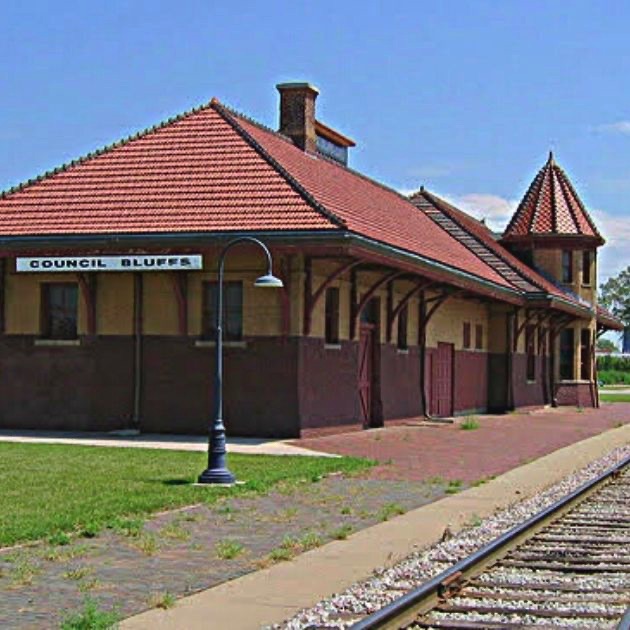
Meanwhile, the Rock Island constructed a new passenger depot in 1899 down on South Main and 16th Avenue which now houses the Historical Society’s Railswest Railroad Museum. At the same time, the Rock Island laid a spur line down 13th Avenue from South 8th west to South 15th Streets with its own bridge across Indian Creek. The city also vacated portions of South 9th and 12th Avenue to make room for a “large roundhouse and machine shops” planned by the Rock Island which had 14 busy railway tracks running across South 9th by 1900.

Council Bluffs had grown to just over 25,800 people by the turn of the 20th century as the Implement District reached it peak years of prosperity with 16 independent implement houses in operation. Union Transfer at 1304 South Main remained among the city’s largest under manager H.I. Forsyth and served as distributors for the Advance Thresher Company of Battle Creek, Michigan; Hart-Weigher Company and R. Herschel Manufacturing of Peoria, Illinois; Hayes Pump & Planter Company of Galva, Illinois; Grand Detour Plow of Dixon, Illinois; Famous Manufacturing of East Chicago, Indiana; the Hoosier Drill Company of Richmond, Indiana; and Chicago’s Columbus Carriage Manufacturing. Peru Plow & Implement was at nearby 1300-1302 South Main and Cahill Wagons was at 1304 South Main. O.P. McKesson was the local manager of Aultman, Miller & Company at 1306 South Main which manufactured their Buckeye line of farm implements out in Akron, Ohio. David Bradley’s stood a few blocks north at 1100 South Main and offered a wide line of wagons and buggies sold under the Bradley brand name in addition to their line of farm implements. J.B. Conner’s contracting was at 1107 South 4th, R.B. Bloomer’s Fence Works on South 4th and 12th Avenue also produced a line of corn cribs, and J.S. Morgan was proprietor of Council Bluffs & Omaha Transfer at 1005 South 4th with an extensive blacksmith shop down the street at South 4th and 11th Avenue.

A variety of smaller businesses also appeared in the Implement District, mostly along South Main, with Erasmus Brown’s drug store at 909, Andreas Christensen’s cigar stand at 913, Pat Gunnoude’s grocery at 915, and G.J. Harding’s barbershop at 921 South Main. Ida Durant ran a restaurant at 1003 South Main, Moritz Cohn’s junkyard was at nearby 1007, Minnie Burke had a restaurant down the street at 1015 and the Depot Hotel was still open under another new name at 1019 South Main. Down on South Main and 15th Avenue was the M.E. Smith shirt factory which employed 75 women to turn out 60-70 shirts a day with Butterfield & Christian’s Saloon at nearby 1509 South Main. J.H. Boysen-Soenke was listed as a “Dealer in wines, liquors, and cigars” at 1600 South 6th Street and was also the local wholesale agent for Lemp Brewing, the first St. Louis brewery and originator of Falstaff.

In 1903, a new four-story warehouse was built for the Fuller & Johnson Company at 1401 South Main. It was destroyed in a December fire just a year later. Nonetheless, by 1905 Council Bluffs could still boast that the city was second in the nation only to Kansas City when it came to the sale of agricultural implements. Diversity in the old district continued and that year Giant Manufacturing first opened with an aluminum foundry on 12th Avenue and another facility on South Avenue. During the company’s long history, Giant produced playground equipment, barrels, floodlights, and truck bodies and received several government contracts during World War II. The Shugart & Ouren Elevator Company was also incorporated in 1905 by Curtis Ouren and Eli Shugart’s nephew Thomas. Their thriving seed business included an elevator at South 6th and 10th Avenue with a capacity of 20,000 bushels.

Fires continued to plague the area and in 1906 the Union Transfer at South Main and 13th Avenue burned. Other nearby businesses during the early 20th century included Kritchmer Manufacturing which re-located from Montgomery County to South 3rd near the Wabash freight house where they manufactured bee-keeper’s supplies and their own Iowa Seed-corn Graders. Also along South 3rd were Parawax Sweeping Compounds at 12th Avenue, Di Giorgio Seeds, and the Growers Canning Company at South 3rd and 9th Avenue which produced canned goods very near where a major food production complex emerged during the latter half of the 20th century.

At the same time, Hay Tool Manufacturing was located outside the old Implement District near the Northwestern tracks on 16th Street and 1st Avenue. The company manufactured hay rakes and Iowa Hay Stackers with Newton McCall as both manager and president and wholesale houses at St. Louis and Kansas City. Down on South Avenue, E. Children’s & Sons continued to manufacture its own line of implements, including Hawkeye Grain Drills, New Badger Cultivators, New Meadow Queen Hay Stacker, and New Meadow, Rancher, and Success Hay Rakes. Other implement companies outside of the old Implement District were located further west along 9th Avenue, including Walker Manufacturing which moved from Rock Island to the southeast corner of South 12th and 9th Avenue where they produced Walker Corn Huskers, Lever Lift Hay Stackers, furrow openers, disc sharpeners, wind mill regulators, stock tanks, and woven wire fence. Also on 9th Avenue on the northeast corner of South 12th was the Alfalfa Meal Company which opened in 1904 to manufacture and sell stock feed while the well-known Kimball Brothers elevator and scale factory was on South 9th and 11th Avenue. In 1908, the city vacated a portion of 13th Avenue between South 7th and the Rock Island yards and granted the property, under certain conditions, to Jensen & Sons Milling & Grain Co.

The implement houses, freight depots, and yards of coal, lumber, and junk also brought more transfer companies to the Implement District, including Slacks Transfer which opened at 1200 South 6th in 1901. Arthur Slack also renovated the old Center Street School down South 6th Street at 13th Avenue into his family’s home. The railroads also continued to expand and in 1902 the “Mason City & Ft. Dodge” was granted rights into Council Bluffs on South Avenue to the south-side of 9th Avenue between 6th and 11th Streets. The city also vacated portions of 14th and 15th Avenues west of South 3rd Streets and the Chicago & Great Western was completed into Council Bluffs by 1903. The Great Western passenger depot was located at 900 South Main with an expansive two-story brick freight depot at 900 South 6th that was 280 feet long and 40 feet wide. Construction of the Great Western also led to the establishment of the town of McClelland which was selected as the location for the Pottawattamie County Home for the Indigent in 1904 and is now the home of SCOLA.

The Burlington was also granted right of way in 1902 to double-track “with all sidetracks, turnouts and switches which may be necessary” down 11th Avenue from South Main west to the U.P. Transfer. Five years later the Burlington was granted rights to build a single track line for 86 feet along the east side of South 4th at 12th Avenue. An icing platform was built on the Rock Island line in 1909 near South 3rd and 18th Avenues. Two years later in 1911 a large freight platform with a crane was constructed in the Rock Island yards along 13th Avenue between South 7th and South 8th Streets.

The many railroad crossings through the Implement District led to more than a few deaths and dismemberments over the years, including nine year old James O‘Neil who was killed at the Great Western crossing at South 7th and 9th Avenue in 1905. Switchman William Cook was killed the next year when he was crushed between two Great Western passenger cars at South 6th and 9th Avenue and in January 1907 Underwood banker Royal Felton was killed at the Great Western crossing on South Main. And while accidents still occasionally occur at busy rail crossings, Council Bluffs sought to relieve some of the problems through the Implement District in 1908 and required gates at the railroad crossings on both South Main and South 6th Streets between 9th and 10th Avenues and between 10th and 12th Avenues. By 1912 Council Bluffs claimed that a freight train pulled out of one of the city’s many freight depots every eleven minutes with another train leaving one of the several a passenger depot every eight minutes.

However, the 1902 merger of McCormick, Deering, and Plano to form International-Harvester was a harbinger of the consolidation to come as a number of implement manufacturers either closed down or were swallowed up. At the same time, the growing affordability of motorized tractors began to drastically transform both American agriculture and the farm implement business. In 1903, Aultman-Miller became part of I-H and Hoosier Drill merged into American Seeding which also eventually became part of I-H. Keystone was sold out to I-H by 1905 and Marseilles became part of Deere & Company by 1911. Both Fuller & Johnson and Gale ended their implement business altogether although Sandwich remained in operation until 1930 when the company was sold to New Idea. David Bradley & Co. moved its factory to Kankakee, Illinois and was reorganized with Edgar Merriam as secretary and treasurer and ultimately vice-president. Merriam also served as president of the Council Bluffs Commercial Club and was among the earliest and enthusiastic investors in the Independent Telephone Company of Council Bluffs. David Bradley was eventually bought out by Sears & Roebuck although Bradley garden equipment remained a staple of their catalogue business for much of the 20th century.

The population of Council Bluffs had reached 35,000 according to the 1910 Polk’s Iowa Gazetteer with several dealers still listed in the old Implement District. Those along South Main included Pioneer Implement at 1000 with F.R Davis as president, Sandwich Manufacturing at 1228 was managed by C.W. McDonald, and Peru Plow & Implement was at 1411 South Main. International Harvester was still located at 1001-1015 South 6th , J.H. Clausen’s at 1218 South 6th housed the local offices for Fuller & Johnson and South Bend Chilled Plow, B.L Brandford was the local manager for the Ohio Cultivator Company of Bellevue, Ohio at 1126 South 6th, and Whitebrook Iron & Metal Company was at 1209 South 6th Street. L. Rosenfeld and Anheuser-Busch’s beer depot was still listed at 507 8th Avenue with Christopher Armstrong’s blacksmith shop at 1013 South 4th and the Bluff House Hotel at 1101 South 4th Street. R.H. Bloomer at South 4th and 12th Avenue had switched from fences and corn cribs to cold storage as president of the Iowa Butter & Egg Company.

By 1910 several implement dealers had relocated up South Main to the newer, much reduced “implement row“ with Frank & Campbell at 229 South Main, the Frohardt Brothers at 612-618, and Bradley, Merriam & Smith at 700 South Main. Other Council Bluffs implement businesses included Appleton Manufacturing of Batavia, Illinois with R.H. Stimple as their local manager, E. Children’s at 2100 South Avenue, and Walker Manufacturing on the southeast corner of South 12th and 10th Avenue. Walker also produced two styles of washing machines during the early 20th century, the Five Minutes and the Gearless. Another early washing machine was manufactured at nearby 608 South Main by the Noiseless Washing Machine Company with O. Linebarger as president.

Businesses through the old Implement District had continued to diversify by 1916 when the city vacated an alley for the expansion of the growing Monarch Manufacturing. In 1919, Consolidated Poultry & Egg Company was located at 800 South Main, Pennsylvania Consumers Oil was at 1102-1111, and the Council Bluffs Hide & Fur Company at South Main and 14th Avenue. Claar Transfer was at 924 South Main while Ford Transfer & Storage at 1102 South Main also housed the Council Bluffs office for King & Hamilton which manufactured farm implements in Ottawa, Illinois. Sandwich Manufacturing was at 1216-1230 South Main with the Friedman-Kerdelson Company at 1214, and the Rock Island Hotel was still open at 1019 South Main. The long-established Toller Grocery was at 1001 South Main, Mary Woods operated a confectionary at 1021, and William Wells was running the restaurant at 1509 South Main near the Rock Island passenger depot. The 1919 city directory also listed Wallace & Geise at 222, Eureka Manufacturing at 600, and Ney Manufacturing at 620 South Main as dealers on new “implement row“ near such agriculturally oriented businesses as harness shops operated by Albert Wichert at 105 and Earl Perry at 127 South Main, Empire Ranch & Cattle Company at 124, Peet Stock Remedy at 511, and Albert Scofield’s feed store at 521 South Main. The Droge Elevator Company was at 518-520 Pearl Street and George Onderkirk still shoed horses down at 631 South Main. For a few years, an early style of tractor was even manufactured in Council Bluffs at 3100 1st Avenue by the Great Western Tractor Company. Originally organized in Omaha, H.A. Searle was president and G.S. Wright was secretary of Great Western Tractor which produced a four-cylinder, 4,900 pound tractor that cost $1,750.

There were still more than 200 farm implement manufacturers in America by 1925 with International-Harvester the largest in the country and Council Bluffs as the I-H campus spread across South Main and South 6th Streets between 10th to 11th Avenues. The number of implement manufacturers continued to dwindle and South Bend Chilled Plow was taken over by Oliver Farm Equipment. The decline was mirrored in the Implement District as many of the old wholesale warehouses were replaced with other industries. From 1924-26 the Mona Motor Oil complex continued to expand down South 6th Street as the company launched KOIL Radio and even had it‘s own recording stars, the Mona Motor Oil Twins. Dwarfies Food opened in 1926 at 1216 South Main and used “dwarfies” cartoon characters to promote their “all wheat“ cereal. The memorable Georgie Porgie Cereal opened at 1102 South Main in 1928 and advertised through children’s coloring books and hiring country and western musicians to promote the company‘s cereal, popcorn, cocoa, and other products both on the radio and at personal appearances around the country. Other businesses in the old Implement District in late 1920’s included the Hurd Creamery on the northeast corner of South 4th and 12th Avenue with an ice plant a half-block west; the Council Bluffs Fur & Hide Company was still at South Main and 14th Avenue; Ouren Seed on the northwest corner of South 6th Street and 10th Avenue; Pennsylvania Consumers Oil on the northwest corner of South Main and 12th Avenue with Standard Oil and the Great Western Fuel Company a few blocks south and east of South Main on 16th Avenue. American National Feed was nearby on South 8th and 9th Avenue, Bluff City Lumber & Coal on the northeast corner of South 4th and 10th Avenue, and the A.I. Root Company was then on South 3rd and 11th Avenue.

By the mid-1930’s International-Harvester at 1000 South Main and King & Hamilton at 915 South 6th were the last implement dealers listed in the old district while the former location of Keystone Manufacturing had become an I-H warehouse. At the same time, several dealers were listed along South Main‘s new “implement row”, including L.H. Katelman & Company at 111 South Main. In 1929 Katelman introduced its own Overland Land Roller and a Badger One-row Cultivator with 50 inch wheels in 1930. Other implement dealers on South Main near Katelman’s included Wallace & Giese at 517, McMillen & Jenkins at 521, and Ney Manufacturing at 620 South Main with John Seidler at nearby 530 South 4th and the J.I. Case Company of Racine, Wisconsin at 624 South 4th Street. Agricultural implements were also still produced well outside the old district by Hay Tool Manufacturing at 1602 1st Avenue and Metal Products Manufacturing at 3121 Avenue A.

Instead of implements, a wide variety of enterprise appeared in the old district with food processing eventually became predominant. The industrial area along South 4th included Bluff City Lumber & Coal at 901, the Geise Company bottling works at 1017, Gooch Food Products at South 4th and 11th Avenue, the Hurd Creamery at 1135, and the Fenlon-Wickham Coal Company on South 4th at 14th Avenue. A similar situation prevailed down South Main with Monarch Industries floodlight factory at 917, Homer Prince’s Poultry at 923, Roy Scofield Feed at 924, William Bowen’s veterinary clinic and Chemical Company at South Main and 10th Avenue, and Atlantic Pacific & Gulf Oil at 1102 South Main. Several seed companies were also operating in the old Implement District with Ouren at 924 South 6th, Council Bluffs Seed at 1000 9th Avenue, and the Younkerman Seed Company at 1218-1220 South 6th. Younkerman had a retail store at 164 West Broadway and advertised “Everything in Field and Garden Seeds” with a “full line of poultry, dog, and bird supplies”. Interstate Transfer was at 1230 South Main, Iowa Distributing at 1303, and Nichols Wire Sheet & Hardware and Kontinental Kompound was at South Main and 14th Avenue. Oriental Coal was at 1427 with Eva Hansen then operating the restaurant at 1509 South Main.

Eva’s was kept busy with the combined Rock Island and Milwaukee passenger depot at nearby 1510-1512 South Main as railroad operations remained a prominent feature of the Implement District. The Rock Island and Milwaukee also shared the services of ticket agent J.E. Strobele who resided at 1034 North Broadway. The two railroads did keep separate freight houses with the Milwaukee’s at 1300 South 6th and the Rock Island’s down the street at 1420 South 6th. The Rock Island’s roundhouse and yard office were at, respectively, 1220 and 1231 South 8th Street, with the Milwaukee‘s yard office down at 2901 South Avenue and the U.P. freight house on South 6th at 10th Avenue. The Burlington passenger depot was at 1201 South Main with freight houses at 1215 South Main near Johnson Transfer, a yard office at 424 16th Avenue, and the Burlington roundhouse at 515 19th Avenue. Council Bluffs operations of the Great Western included the freight depot at 900 South 6th, passenger depot at 900 South Main, and the roundhouse at 300 15th Avenue.

Fuel companies were also abundant near old implement row with Western Fuel at 920 South 6th, Red Giant Oil and the Mona Motor warehouse at 1024 South 6th with the Mona Motor office down the street at 1126. Mona Motor also had its own service stations at 637 and 3759 West Broadway, 520-522 South Main, and 1601 South 7th Street. Joe and Maurice Katelman’s Council Bluffs Junk Company was at 1125 South 6th with the Katelman Iron Yards at 1221. Drew and Hannah Collingwood ran a restaurant at 1510 South 6th with Max Mason’s barbershop at 1518 South 6th and Max Henningsen’s restaurant at 1522 South 6th. The Continental-Keller warehouse was at 619 9th Avenue, Jack Boyne’s contracting at 900 9th Avenue, and Andrew Oien‘s blacksmith shop at 412 10th Avenue. Hyman Haldeman ran a restaurant at 410 11th Avenue and Shoemaker’s Coal for Cash was located at 515 13th Avenue.

Blue Star Produce was in business at 12th Avenue and South 4th Street by 1938. Blue Star would expand greatly over the years, particularly with government contracts for powdered eggs and a multitude of other products. Blue Star was also where many folks from a couple generations found their first employment working on the line. Howard’s Plastics opened in 1941 at 1401 South Main and also profited from wartime contracts to produce radio crystals during World War II. At the same time, Georgie Porgie had closed by 1940 although Petersen Implement operated in the old District during the 1940’s at 925 South 6th Street. Devastating fires continued and the Great Western freight house burned in September 1935. Three city firemen were injured fighting a blaze in November 1945 that damaged Younkerman Seed on South 6th and 13th Ave. An August 1947 fire at Dwarfies Food at 1216 South Main halted production at the factory which was then operating with three shifts, 24 hours a day, and the company later relocated to West Broadway and 40th Street. In November 1950 Fireman William Cavett died of a heart attack while fighting a fire that swept along South Main’s new “implement row” and destroyed the Breeders Supply Company warehouse, L.H. Katelman Hardware, South Main Furniture, and Nick’s Tavern. Likewise, another fire struck the old Implement District in October 1952 and destroyed a garage owned by Blue Star and the old implement warehouses in the 1500 block of South Main used by Continental-Kellar Furniture as winds whipped embers 15 blocks north into downtown.

In 1940 the Milwaukee’s Midwest Hiawatha joined the Arrow along with the Rock Island Rockets and Burlington Zephyrs that made daily stops at the depots in the old Implement District and in late 1948 the Burlington built a two-story brick tower near the yard office to control traffic on the line between the UP Transfer and Pacific Junction. However, the Great Western brought an end to service on passenger trains 31 and 32 out of Council Bluffs in October 1949 as passenger service gradually withered away during the next two decades. That same year the Witthauer Building was constructed at 1510 South 6th which has long been home of the occasionally infamous Glass Front Tavern which, incidentally, once actually had a glass front. Another change came in 1955 after the Union Pacific ended its age-old agreement with the Northwestern and instead switched all passengers and freight out of Council Bluffs over the Milwaukee line. At the same time the Milwaukee switched its color scheme from traditional bright orange to yellow. Other changes in Council Bluffs included the 1956 construction of a new Council Bluffs depot and yard office for the Great Western on South 3rd and 15th Avenue and a new diesel engine house was built a year later on the northeast corner of South 3rd and 18th Avenue.

In 1964 the Wabash was taken over by the Norfolk & Western and in September 1965 Great Western passenger train 14 made its last run from Omaha to the Twin Cities. Operations of the Great Western in Council Bluffs and everywhere else came to an abrupt end with the 1968 merger with the Chicago & Northwestern. Howard’s Plastics at 1401 South Main closed down in 1959 and in 1960 Dr. Lee R. Martin died. Dr. Martin had established the South West Iowa Handicapped Center and offered free cerebral palsy clinics which continued as the Dr. Lee Martin Therapy Center at 1017 South Main until 1995. That building still stands and is presently used as Con-Agra’s General Store. In December 1966, yet another fire in the Implement District destroyed the two-story Katelman Brother’s warehouse at 1125 South 6th which had once housed the local office of the Ohio Cultivator Company. This was also where City Councilman Joe Katelman was attacked in 1956 with a pearl-handled .38 over a land deal gone bad. The assailant’s final shot missed after the future Mayor slipped and fell on the sidewalk out front but Katelman still needed 42 stitches in head.

The Burlington ended service on the Ak-Sar-Ben Zephyr out of Council Bluffs in 1970 although the Nebraska Zephyr still stopped in town twice daily at 11 AM and 8:17 PM for one more year. By 1972 Jennings Coal at 1401 South 6th was the last coal dealer left in the old Implement District and closed for good shortly afterwards. Construction of the South Expressway Viaduct on the west edge of the Implement District also resulted in the removal of several structures, including the Great Western freight house on 9th Avenue between 6th and 7th Streets. In August 1979, 34 years after it was damaged in a fire, Younkerman Seed at 1218 South 6th burned again. The Milwaukee Railroad went out of business by 1980 and was soon followed by the Rock Island. Arson was blamed for a February 1981 blaze that destroyed the Hy-Brid Seed Company on South 6th and 10th Avenue and the Burlington‘s control tower on 16th Avenue closed in 1982.

By April 1983, businesses in the Implement District included Farm Bureau Service’s fertilizer plant at 1227 South Main with 20 employees, Prestige Furniture at 1216 South Main had 36 employees, and Giant Steel Containers at 1026 South 6th was down to just four employees. In December 1983 the last 15 cars of the Norfolk & Western rolled south out of Council Bluffs after the railroad sold the 222 miles of track down to Kelly, Missouri. The line was briefly taken over by the Colorado & Eastern before becoming the Wabash Trace Nature Trail and Council Bluffs has recently started to transform part of the old Wabash right-of-way into the city into a bicycle trail. In 1984, Giant finally closed for good although some of the playground equipment the company produced for several generations of children remain in use, including several examples at the Glenwood Lake Park.

More changes came after Blue Star Produce was sold to Con-Agra in 1990’s. The facility’s expansion ultimately resulted in the razing of several historic buildings, particularly the two-story brick Main Street Saloon with its stone detailing at 1013 South Main and David Bradley & Company’s four-story warehouse on the west side of South Main. Further attempts at re-development in the old Implement District during the early 21st century resulted in the demolition of the Mona Motor complex at 1026 and 1103 South 6th Street. Council Bluffs also received two “Brownfields” grants from the EPA to assess potential contamination in the old industrial area.

Today, the sidewalks through the old Implement District are cracked and crowded with far more weeds than workingmen while the horse teams and heavy trucks of the transfer companies no longer rumble down the cobblestone streets. Vacant lots have all but replaced both the brick warehouses and the plethora of saloons, restaurants, and hotels that once served the workers, salesmen, farmers come to town, and the many passengers and drummers in transit between the depots. At present, the early 20th century Atlantic, Pacific & Gulf gothic filling station still stands at 1200 South Main and the 4-State Supply warehouse now sits on the site where Keystone once wholesaled their harrows. The 1899 Rock Island passenger depot and Union Pacific freight house, Acorn Supply on 16th Avenue and Amerco Feed on South 7th, the McCormick and Pioneer Implement Buildings on 10th Avenue, the Sandwich/Dwarfies Building at 1216 South Main, AA Pallet at 1402 South Main and Palleton Incorporated at 1301 South 6th, the Glass Front Tavern in the 1949 Witthauer Building, the 1956 Great Western depot on the Con-Agra campus, and the freight trains that still occasionally block the streets are now the only reminders left of the untold and unsung thousands of sulky plows, reapers, wagons, manure spreaders, seeders, hay rakes, cultivators and threshers that went from Council Bluffs into helping make the Midwest the breadbasket of a nation.


The Historical Society of Pottawattamie County, Iowa was founded in 1934 and is a 501 (c) 3 non-profit organization dedicated to kindling and keeping alive an active interest in state and local history.  Contributions and inquiries should be directed to the Society  at P.O. Box 2, Council Bluffs, Iowa 51502-0002.  For additional information, phone 712-323-2509 or e-mail us here.

This site is optimized for Microsoft Internet Explorer, and not all features may work with certain other browsers.  Please let us know about site issues you encounter.

Copyright © The Historical Society of Pottawattamie County, Iowa