
|


| |
Historic
Pottawattamie County
Squirrel Cage Jail
|
| contributed
by Ryan Roenfeld |
|
|
The unique Squirrel Cage jail in Council Bluffs served as the
Pottawattamie County Jail from 1885 until 1969.
|
|
|
| History
of the Pottawattamie County Squirrel Cage Jail |
| |
The unique “Squirrel Cage” rotary jail in Council Bluffs served as the
Pottawattamie County Jail from September 1885 until December 1969. It was
America’s largest rotary jail, an idea first patented in July 1881 by
William Brown and Benjamin Haugh of Indianapolis. The purpose of the new
jail was "to produce a jail in which prisoners can be controlled without
the necessity of personal contact between them and the jailer." In
addition, a rotary jail would provide "maximum security with minimum
jailer attention." In many ways, the rotary jail mirrors some of the
theories behind Jeremy Bentham’s Panopticon invented as “penal
imprisonment, from the beginning of the nineteenth century, covered both
the deprivation of liberty and the technical transformation of
individuals.“ According to Michel Focault, the Panopticon consisted of
cells arranged around a central tower, “so many cages, so many small
theatres, in which each actor is alone, perfectly individualized and
constantly visible.” Strict segregation was intended for “individualizing
observation, with characteritization and classification, with the
analytical arrangement of space.” Brown and Haugh’s rotary jail dispensed
with the central tower and constant observation in favor of a what one
Iowa State Professor later called a “device in which human welfare had
been sacrificed for security and the convenience of the jailer…”
In spite of future problems, the supposed effectiveness of
the rotary jail and its low costs of operation soon came to the attention
of the Pottawattamie County Board. In 1882, architects Eckel and Mann
first supplied local officials with designs for a new county jail and
members of the county board approved plans for the new jail two years
later. In early 1885, county officials headed south to Missouri to inspect
the jails at Saint Joseph and Mayville. Finally, in what would become a
rare occurrence through the years, a bond issue was passed in
Pottawattamie County on March 10, 1885 with 5232 voters in favor of
building a new courthouse and jail and 2933 opposed.
Bids to start construction of the new jail were opened in
April 1885 and work was completed in just five months. According to
The Council Bluffs Globe, the new jail cost the taxpayers not quite
$30,000 with $21,000 of the sum for the metal from Haugh & Ketcham's
Indiana foundry. General contractors were Wickham Brothers of Council
Bluffs who also did all the masonry work. The outside walls of the jail
are three layers of brick thick while all interior walls are two layers
thick. Other Council Bluffs workers included John Epenter, who supplied
the jail's metal cornice and slate roofing, carpenter G.S. Lawson, and
painter B. Terwillinger.
On September 11, 1885 the Council Bluffs Globe reported
that Sheriff Theodore Guittar, Jailer Schontz, and Constable McFadden had
moved the first inmates into the jail. The first guests at the Squirrel
Cage included murderer Cuff Johnson, horse-thief Miles Mullen, forger
Frank Scofield, confidence man Ed Rankin, John Gordon who had violated the
revenue laws, and Mr. And Mrs. Brock and their teenaged daughter had been
transferred from Manning, Iowa and were all imprisoned for larceny.
During its 84 years of operation the jail would host a
colorful mix of prisoners although as early as 1887 the Council Bluffs
Globe declared the jail "pretty near a failure" as it would not rotate
properly on its axis. In March 1896, the Nonpareil reported that
the previous jailer had left the jail in a “filthy condition” for newly
elected Sheriff Morgan. The jail, which held 32 prisoners at the time,
was renovated and cleaned with three new coats of paint added inside. The
cylinder itself was painted three different colors, the walls were painted
white, and the stairs and railings jet black. The cost of the renovation
was $1,000, which included a new supply of bedding for prisoners. Just
six years later in 1902, a Council Bluffs Grand jury had condemned the
city’s jail but found the Squirrel Cage in "good, sanitary condition."
Future inspections would be much less generous. In August 1904 the
Nonpareil reported that the Jail got stuck for three days. The rotary
cage was “used only at night” and during the daytime the 10 prisoners then
incarcerated were “let out into the corridor”. Four years later in 1908,
a different Grand Jury condemned the Squirrel Cage as a “crusty clink”
health hazard. The Jail would ultimately be condemned by over two dozen
similar Grand Juries through the years, mostly for the same reasons,
typically sending the Sheriff and county officials scrambling to find the
necessary funds to keep the place operational.
In spite of its justifiably notorious reputation, a few good
times at the jail also appeared in the newspaper. One November 1918
article described the annual Thanksgiving dinner given to the 30 men and
one woman then incarcerated at the Squirrel Cage. According to the
article, the “hospitality of the jailer and the home cooking of his wife,
brought smiles to the faces of each unfortunate and they were the
recipients of hearty and sincere congratulations.” The Thanksgiving
dinner served to prisoners that year included celery soup, a
Prohibition-era Manhattan cocktail, the “Kaiser’s Goat” (which was
reportedly intentionally too tough to eat), roast goose with dressing,
mashed potatoes, creamed peas, olives, bread and butter, coffee, assorted
pies a la mode, and cigarettes. Other times were far grimmer. Although
the jail was designed to house a maximum of about 85 prisoners, the
Squirrel Cage reached its probable maximum capacity in 1929 when 165
prisoners were reputedly incarcerated there.
In November 1960, the Squirrel Cage was closed for a variety
of renovations. District Court Judges had not sentenced anyone to the
Jail since mid-September as the jail had become “unfit because of health
and safety reasons.“ Five prisoners were escorted across the street to
the Council Bluffs Jail located on the second floor of City Hall and three
others were hauled down to the Page County Jail at Clarinda. According to
Jailer Bill Foster, “It’s going to be pretty quiet around here until we
are back in business again.” The costs of renovation and improvements
were estimated at $4,000. Sheriff Roy Wichael held an “open house” at the
county jails in Council Bluffs and Avoca for public inspection. When the
jail re-opened, America’s largest rotary jail had been fixed in place and
has not rotated since.
Nonetheless, the last nine years would prove to be some of
the Squirrel Cage’s most interesting and contentious as its continued use
became a source of head-shaking amazement. In spite of the various
improvements, the Jail remained a sore spot with Sheriff Wichael who
complained to the Des Moines Register in 1961 that the Squirrel
Cage had been “condemned a dozen times by the county board.” The Jail
underwent another facelift at the same time when the Sheriff’s Department
moved its offices into the basement of the neighboring Courthouse. Just
three years later, a $440,000 bond issue to construct a new jail failed at
the polls and the District Court ordered the Squirrel Cage closed for six
months for its various “inadequacies and deplorable conditions.”
One indication of the Jail’s future came in October 1965 when
an official of the U.S. Department of the Interior recommended that the
structure should be preserved as an “oddity.” Nonetheless, the Squirrel
Cage’s time as a jail were truly numbered. According to the Nonpareil
in December 1968, the Iowa Department of Social Services informed the
Pottawattamie County Board that the jail should “not be used to confine
inmates” and cited a laundry list of reasons compiled by Iowa’s Chief Jail
Inspector (and former Council Bluffs Chief of Police) William Swassing.
According to Swassing’s report, the Jail’s deficiencies included lack of
individual cells with all prisoners housed together regardless of the
severity of their crimes and that the jail was unsafe for officers due to
numerous blind spots, noting that the “jailer refuses to enter the cell
block alone.” Staff also had limited control over the cell block while
the 83 year old building’s electrical wiring was “old, inadequate, and
exposed,” the lighting inadequate, and the plumbing “old, deteriorated,
and often backs up” making sanitation “extremely difficult.” Furthermore,
the kitchen was too small, the roof leaked with pans placed everywhere
whenever it rained, the food supplies froze solid on occasion in winter,
and there was no place for “recreation, rehabilitation, segregated
quarters for work release inmates or counseling and visitation….”
In spite of the County Board’s pleas to officials in Des
Moines to bring the Jail up to code, the Squirrel Cage was closed for good
on December 1, 1969 following the failure of a $220,000 bond issue to
build a new correctional facility. The 11 prisoners held inside were sent
to the Page County Jail in Clarinda at a cost of $10 each per day with an
additional $10 charge for each woman prisoner. The Squirrel Cage’s last
Jailers, Jesse and Gladys Poor, were prepared to move out by the middle of
the month. At the same time, Frederic Schlott, Chairman of the Council
Bluffs Park Board, was leading efforts to preserve the jail as a good bet
for a tourist draw. Demolition was narrowly avoided and the Council
Bluffs Park Board purchased the Jail for $5,000 the next year and agreed
to operate the property with the Historical Society of Pottawattamie
County.
Although over $10,000 was spent on badly needed renovations, in the late
1970’s the Squirrel Cage was once again threatened with demolition by
Pottawattamie County officials seeking to enlarge the parking lot of the
new courthouse. The Des Moines Register profiled the battle in a
June 1977 article whether or not the Jail was a “mechanical marvel of
historic importance” or “an affront to taxpayers who are being cuffed for
nearly $5 million for a new courthouse”. The Pottawattamie County Board
of Supervisors unanimously voted that the Jail should be “fixed up,
destroyed, or moved” with Supervisor Don Smith declaring the 1885
building “an eyesore…” A reprieve was announced that same month when the
Council Bluffs City Council voted to lease the Squirrel Cage to the
Historical Society of Pottawattamie County for a dollar a year. The next
year, the Jail was sold to the Historical Society for $8,001. The
Historical Society of Pottawattamie County has continued to operate the
Squirrel Cage ever since as one of the most unique museums in the country.
|
| Operation |
|
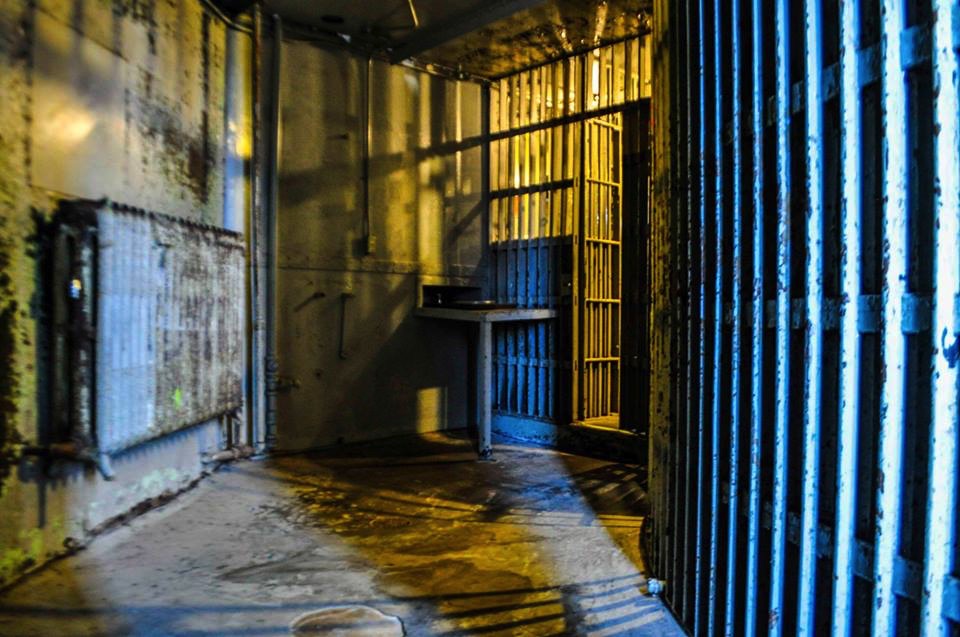
The jail's rotary cylinder remained in operation for 75 years although it
suffered from a variety of malfunctions from almost the beginning. The
cylinder is 28 feet high, 24 feet in diameter, weighs just over 20,000
pounds empty, and is suspended from an iron beam on the fourth floor. The
cylinder, cage, and all other metalwork was shipped to Council Bluffs from
the Haugh and Ketcham Ironworks in Indianapolis. The cylinder has three
floors with ten pie shaped cells on each floor designed to hold two
prisoners per cell. Since there was only one entrance or exit on each
floor the entire cylinder had to be turned with a hand-crank until the
cell was lined up with the opening in the cage. For additional security,
a water wheel was also reputedly used to continuously rotate the Squirrel
Cage at night when the Jailer went to bed. Undoubtedly, the resulting
racket would make sleep almost impossible and any evidence of this power
source was removed long ago.
|
| Architecture |
|
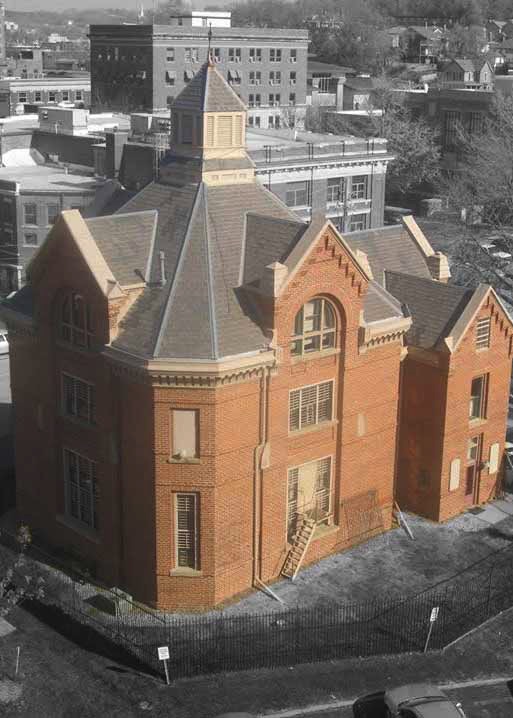
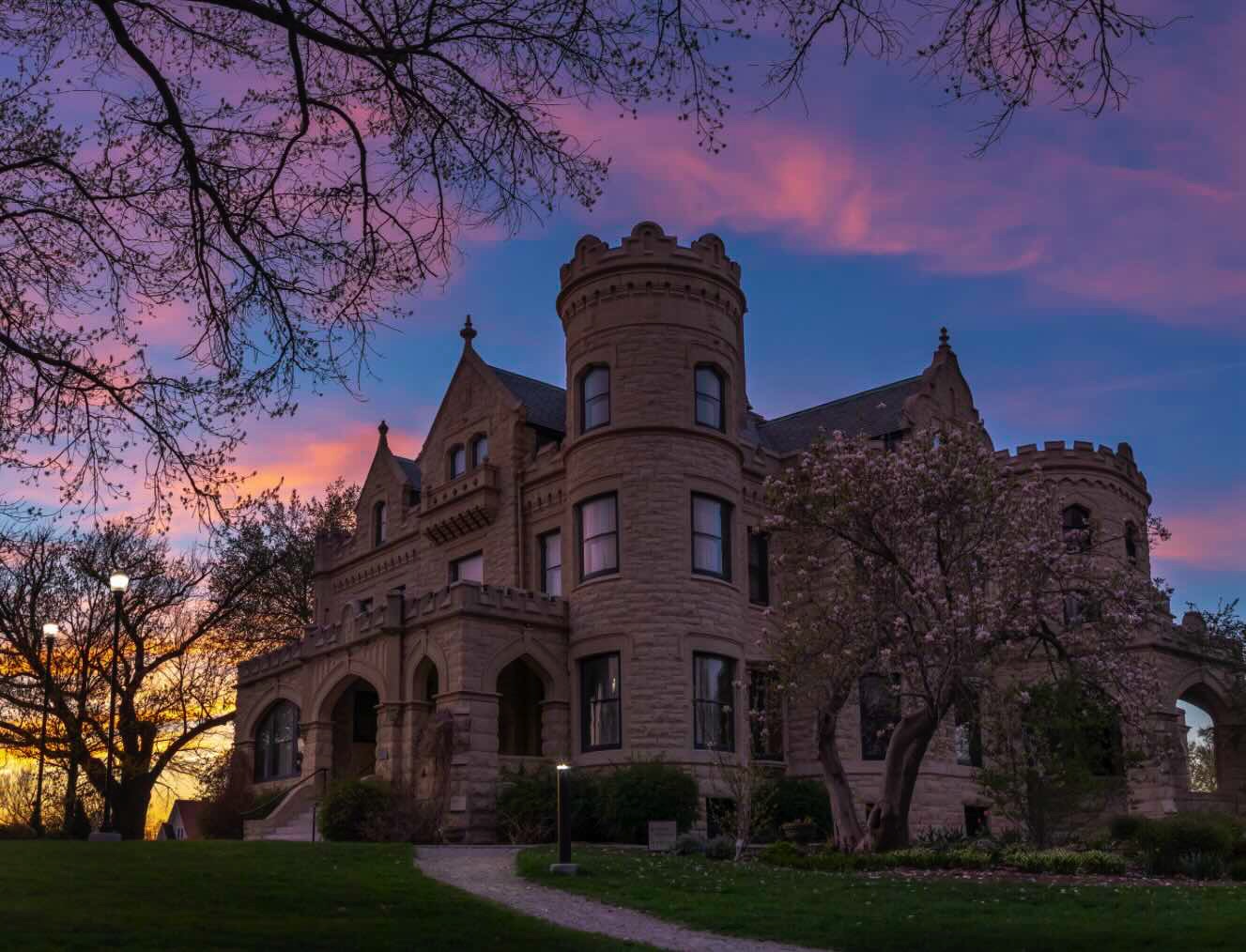
The 1885 Pottawattamie County Jail is a Victorian Gothic styled
building with detailed brick work and limestone trim.
Other notable qualities include the building's tin cornice work,
slate roofing, and cupola. The
structure's elaborate exterior brick work and Romanesque arched windows
on the upper story stand in stark contrast with the building's metal
interior and grim purpose. The three-tiered Squirrel Cage is located in the octagonal
rear section of the jail with additional cells for women, juveniles, and
trustees above the office and kitchen and an apartment for the Jailer
and his family on the top floor.
The jail was designed by the renowned architectural firm headed
by Alsatian immigrant Edmund Jacques Eckel and Hoosier George Mann.
Eckel was apprenticed to a prominent contractor at the age of
thirteen and later worked with the official City Architect of
Strasbourg. In 1864 he entered the 116 year old Ecole des Beaux Arts in
Paris a year after the school first became independent of the French
monarchy. Eckel immigrated
to the United States soon after graduation and while on the train from
Omaha to Kansas City stopped in Saint Joe in July 1869.
He found work as a draftsman in the bustling Missouri city which
was then undergoing a building boom during its quick recovery from the
Civil War.
Eckel's reputation had spread by 1873 when he started his own
company and his work included an opera house in Lincoln, Nebraska, the
German Catholic School and home of the Sisters of Charity in Saint Joe,
and residences ranging from fancy brick homes for the well-to-do to
humble frame tenements. In
1880 Eckel went into partnership with his former draftsman George Mann,
a native of Indiana who was educated at the Massachusetts Institute of
Technology. Warehouses and
mansions made up some of the firm's first contracts and in 1881 they
were selected to design a new Nodaway County Courthouse and Jail at
Maryville, Missouri. The
courthouse featured a 111 foot clock tower and the new jail was designed
as one of the first rotary jails built in the country.
The pair were chosen as architects of the Pottawattamie County
Courthouse and rotary jail soon afterwards.
During these years Eckel and Mann also designed the Atchison
County Courthouse in Rockport, Missouri; the Gentry County Courthouse in
Albany, Missouri; and the DeKalb County Courthouse and rotary jail in
Maysville, Missouri.
After briefly ending their partnership, Eckel and Mann renewed
their business in 1887. A
year later they hired New York native Harvey Ellis as their draftsman
and in 1889 Eckel and Mann designed Saint Joe's German-American Bank.
Ellis is largely credited for the intricate ornamentation on the
firm's later works which grew even more elaborate in detail.
In 1890 the firm received what was to be their most prestigious
contract when they won a national competition to design Saint Louis City
Hall which remains a prominent landmark today.
Based on a French hotel, the four-story building contained 150
rooms and cost around two million dollars to finish in time for the 1904
Louisiana Purchase Exposition.
In 1890 Eckel and Mann dissolved their partnership once again.
George Mann remained in Saint Louis to work with Ellis and then
moved to Arkansas where he designed a variety of buildings in Hot
Springs, Eldorado, and the Arkansas State House in Little Rock.
Harvey Ellis drifted back to New York and worked with Gustav
Stickney whose Craftsman and Mission designs swept American architecture
in the early 20th century. Ellis
drank himself to death in 1904.
Edmund Eckel remained in Saint Joe where his work included
designing the city's Union Station, High School, and Livestock Exchange
Building. From 1903 to 1905
Eckel and Mann briefly renewed their partnership.
Mann then returned to Arkansas where he died in 1939.
Eckel's later designs in Saint Joe included the Immaculate
Conception Church, City Hall, and the fourteen story Corby-Forsee
Building which was built in 1909 as the city's first and only
skyscraper. Edmund Eckel
died in 1934 although the firm he began still exists today under the
name of Brunner & Brunner.
|
| Other Pottawattamie County Jails |
|
Pottawattamie County's first jail, the "Old Cottonwood"
was built in 1849 at what is now 216 First Street.
It was constructed out of cottonwood logs with iron spike driven
through the walls to impeded tunneling.
The county sold the jail to the City of Council Bluffs in 1862
and the building was hauled a few blocks away to the corner of Vine and
Second Streets where it was used as the city "calaboose" until
1866 when it burned to the ground with one prisoner trapped inside.
Also in 1866, the Pottawattamie County Board purchased three lots
on the corner of what is now Pearl Street and Ninth Avenue to build a
new Courthouse with a jail located in the basement.
The new courthouse and jail cost $50,000 and was completed during
the winter of 1868. Just 16
years later in June 1884 the damp jail in the basement was declared
unfit and the Courthouse building was condemned by Council Bluffs City
Marshall Guanella that November. A
month later in December 1884 the Council Bluffs Health Board gave county
officials just three days to evacuate the courthouse building and
offices were temporarily moved into the Masonic Temple at Fourth Street
and West Broadway.
The
top floor of the current Pottawattamie County Courthouse was originally
designed as the county's new jail that also held city prisoners after
1977 when the jail at Council Bluffs City Hall was closed.
Overcrowding at the county jail proved problematic with a record
75 prisoners incarcerated during November 1994.
A new Pottawattamie County Jail finally opened in 1999 on the
north side of Council Bluffs with a capacity of 286 prisoners.
|
| Lynch Mobs |
|
Although no prisoners were ever taken out of the Squirrel Cage
there were a few close calls. In
1894 a crooked foot-racer and gambler Leon Lozier was accused of
molesting a five year old neighbor girl at a duplex at 1115 Avenue D.
By nightfall, a restless mob estimated at 2,000 people had
gathered out front where the door was blocked by Pottawattamie County
Sheriff John Hazen, four deputies, Council Bluffs Chief of Police John
Scanlan, and three city police officers.
Apparently, black man named John Berger forced his way to the
front of the crowd and shouted that if the suspect would have been black
they would have already lynched him. "Give me the rope, I will lead the crowd!" Berger
cried out before officers escorted him from the premises. To help control the situation, 29 soldiers armed with
Winchester Rifles were called out from the Dodge Light Guards Armory.
The frustrated lynch mob slowly dispersed after midnight and
Lozier was taken to the Mills County Jail in Glenwood for safekeeping.
Nine years later in December 1903 there were several reports
of women in Council Bluffs being robbed of their belongings while
walking down the street. Police
were eventually led to a four bedroom "shack" at 1508 Third
Avenue where several stolen items were recovered and two black men,
Neely Zimmerman and George Burk, were arrested.
The pair were taken to the Squirrel Cage and placed at the rear
of the top tier of cells and rotated away from the platform.
At the same time, the keys to all cells were taken out of the
jail as five jailors, with orders to "shoot to kill," put up
steel barricades and armed themselves with Winchesters, repeating
shotguns, and revolvers. Their fears were well founded as that night a crowd gathered
in front of the jail and were egged on by ex-convict "Dutch"
Stevenson and a few others to storm the jail.
At a quarter to one in the morning Company L of the 51st Iowa
Regiment were called out to the jail to restore order and were backed up
by 50 local citizens determined to avert the lynching.
The crowd faded away although the soldiers remained in position
in front of the jail until 4:30 the next morning.
"Dutch" Stevenson
was arrested the next day for attempting to incite a riot and it
came out that his true motive was to free his associate Michael C.
Rogers, ringleader of the "Rogers' Gang," who was being held
at the Squirrel Cage charged with killing Bert Forney while robbing
Forney's saloon at 1028 West Broadway.
Nonetheless, Sheriff's deputies spirited Zimmerman and Burk out
of town later that day for safekeeping before trial.
|
| Escapes |
|
There were numerous escape attempts during the jail's 84 years in
operation and some of them were even successful.
Council
Bluffs resident Dallas Birt escaped from the Squirrel Cage in 1938 when
he forced a hole through the ceiling of the jail's hospital and slid
down an outside ventilation pipe. He was captured soon afterwards after his own father turned
him in. Four years later,
Birt escaped from the jail again, this time by sawing a bar out of a
second-story window. Birt
was captured just four days later while in the possession of burglar's
tools.
In July 1949, two prisoners walked away from the jail during
church services and then robbed two gas stations at gun-point before
they were recaptured. Two
months later, the same pair were involved in another escape when five
prisoners got out of the Squirrel Cage by digging a hole through the
18" thick brick walls. Three
of them were caught in Council Bluffs the next day and the other two
were thought to have fled south to Missouri.
|
| Prisoners |
|
A variety of notorious criminals were guests of Pottawattamie
County at the Squirrel Cage through the years.
Two of the most bloodthirsty were Charles Brown and Charles
Kelley, "The Mad Dog Killers" according to their hometown
Minneapolis newspapers during their three-state mass murder spree in
1961. That February, Brown
and Kelley killed a man while robbing an Omaha liquor store.
The next day, the duo found themselves in Council Bluffs where
they shot Alvin Koerhsen five times in the 800 block of Third Avenue for
his blue Chevy. Koerhsen
died two days later but that night his Chevy wouldn't start for his
killers so Brown and Kelley went and found Kenneth Vencel and his Ford
in the parking lot of a grocery store on Eighth Street.
Vencel was forced to drive them at gunpoint to 10th Street and
Avenue D where Kelley and Brown ordered Vencel out of his Ford and then
shot him repeatedly. Vencel
survived though and was talking to police while Brown and Kelley made
their way north to Missouri Valley.
The pair bought tickets to Kansas City and sat around drinking
beer while waiting for the bus to arrive.
But it didn't take long for the duo to attract a bit too much
attention and suspicions were quickly aroused.
They boarded their bus only to be captured shortly thereafter at
a roadblock on the north edge of Council Bluffs.
Although both men were armed, they were taken into custody
without a shot being fired. Brown
was executed by hanging on July 24, 1962 at the penitentiary in Fort
Madison, Iowa with Pottawattamie County Sheriff serving as executioner.
Brown was the first man executed by the State of Iowa in a
decade. When Kelley joined
his partner at the end of a rope that September, he became the last man
executed by the State of Iowa which abolished capitol punishment in
1965.
|
| Farmers' Holiday Strike |
|
One
of the most unusual incidents in the jail's history occurred during the
first years of the Great Depression.
As the price of produce sank to new lows, many desperate Iowa
farmers gathered in 1932 to form the Farmer's Holiday Association under
the leadership of Milo Reno. That
year some local farmers blocked the roads into Council Bluffs in order
to inflate prices paid for farm produce.
After violence broke out at the pickets on Highway 275 84
protestors were arrested and taken to the Squirrel Cage.
Several hundred sympathetic farmers mostly from Plymouth County
then came to Council Bluffs to protest.
Out of fear that the angry farmers would storm the jail and set
the prisoners free, the police department used machine guns to turn the
grounds of the jail and courthouse into a "no-man's land".
One officer died during the confusion after he shot himself
inside the jail.
|
| Pottawattamie County Sheriffs, Deputies, Jailers, and Matrons
|
|
Theodore
Guittar was Sheriff of Pottawattamie County when the Squirrel Cage first
opened in 1885. Born in
Saint Louis, his father Francis Guittar had first come to southwest Iowa
as a fur trader in the 1820's and had opened one of the first stores in
Council Bluffs in 1852 in a log building on the corner of Main Street
and Broadway. Three years
later thirteen-year old Theodore joined his father in Council Bluffs
where he remained until enlisting in the Second Iowa Battery during the
Civil War. Theodore
returned to town after the war and worked as a Deputy Sheriff for two
years and then served as Council Bluffs City Constable.
Theodore Guittar was first elected Sheriff of Pottawattamie
County in 1881 and was re-elected two years later.
In 1890, he became the U.S. Deputy Collector of Internal Revenue
in Council Bluffs.
Edward
Canning served as City Marshal of Council Bluffs from 1894 to 1898 and
also served as the city's Chief of Police those last two years.
Canning served two terms as Sheriff of Pottawattamie County and
was first elected in 1902. Canning later became a real estate dealer locally and then
with the Canadian Pacific Railroad.
He died in San Francisco in 1930.
Canning Street in Council Bluffs is named after Edward's father
whose home stood along the street.
Robert
and Eva Heller served as Jailer and Matron early in the 20th century.
Natives of Avoca, Robert Heller was a veteran of the
Spanish-American War.
William
"Bill" Duff was Pottawattamie County Chief Deputy from 1932
until 1938 and lived at 526 Fourth Street.
After working as a deputy, Duff worked as a carman for the
Chicago & Northwestern Railroad until he retired in 1947. He died in 1961.
In
January 1949 Otto Gudath was appointed Jailer and his wife Matron.
Born in Louisville, Kentucky, Otto moved to Council Bluffs in
1912 and worked as a butcher for thirty-six years of his life.
Emmett
Hannan was elected Sheriff in 1958 and did much to modernize the
department. A Democrat,
Hannan appointed Roy Wichael Chief Deputy and replaced much of the
staff. Tim Ryan of 3037
Avenue A replaced Arthur Schuelzky as night Jailer, Mr. And Mrs. W.C.
McDaniel replaced the Gudath's as day Jailer and Matron, and W.E. Glaser
was named relief Jailer.
Two
years later in 1960,
Wilman
T. "Bill" and Louise Foster were hired as Jailer and Matron in
1960. Bill Foster was born
in Naper, Nebraska and came to Council Bluffs in 1932.
Louise died in 1966 and Bill retired two years later.
He lived at 1510 Avenue A until his death in 1979.
William
R. "Bat" Masterson was appointed Chief Deputy Sheriff in May
1960 after spending nine years with the Council Bluffs Police
Department. A native
of Shenandoah, Masterson served in World War II who moved to Council
Bluffs in 1949. When Masterson resigned in 1964 he was living at 1244
Fairmont Avenue.
Joseph
Mitchell was appointed Deputy in October 1961.
A native of Honey Creek, Mitchell had served as a Marine during
the Korean War and lived at 3443 Avenue A.
Hiram
"Hi" Jefferson Carter served as Pottawattamie County Deputy
Sheriff from January 1, 1945 until January 1, 1975.
He died that July.
|
| Other Rotary Jails |
|
A total of eighteen rotary jails are thought to have been built
altogether around the country but details remain sketchy.
The majority of America's rotary jails contained two tiers of
cells and were constructed by the Pauly Jail Building and Manufacturing
Company of Saint Louis, Missouri. Today,
only three remain standing and all are open to the public as museums
showcasing one of America's more peculiar methods of penal
incarceration.
-
Crawfordsville,
Indiana: America's first rotary jail was built for Montgomery County in
1882 with sixteen cells and living quarters for the Sheriff.
In 1930 the jail was declared "old, insecure, and
unsafe" by the Indiana Board of Charities but continued to rotate
until 1939 and remained the county jail until 1973.
-
Maryville,
Missouri: The Nodaway County Jail in Maryville was the first rotary jail
designed by Eckel and Mann and was constructed in 1882 by F.C. Allen.
The cylinder was welded in 1904 after one prisoner's head was
crushed while the jail was turning.
-
Gallatin,
Missouri: The Daviess County Jail was constructed in 1888 by B. Pauley
and the Jail Building and Manufacturing Company. The small one-story
jail contains eight cells and is attached to the larger brick Sheriff's
residence. The cylinder
stopped revolving in 1964 but remained in use as the county jail until
it was closed in 1975.
-
Maysville,
Missouri: The DeKalb County Jail was also designed by Eckel and Mann
with eight cells. It
remained in use until 1938 when both the jail and neighboring courthouse
were demolished.
-
Wichita,
Kansas: The Sedgwick County Jail was built between 1884-87 with space
for sixty prisoners in the rotary cylinder and 150 total prisoners.
The jail closed in 1921 and the interior metal-work was donated
to the Wichita Zoo.
-
Grayson
County, Texas: Built 1887
-
Appleton,
Wisconsin
-
Salt
Lake City, Utah Territory
-
Pueblo,
Colorado
-
Oswego,
New York
-
Burlington,
Vermont
-
Dover,
New Hampshire
-
Charleston,
West Virginia
-
Paducah,
Kentucky
- Waxahachie,
Texas: the Ellis County Jail was built in 1888 with twenty cells.
|
| Old Pottawattamie County Courthouse |
|
Construction of a new Pottawattamie County Courthouse in
Council Bluffs took place at the same time as the Squirrel Cage and was
also designed by architects Eckel and Mann.
The white limestone building was designed in the Second Empire
style with steep mansard roofs, projecting pavilions, a central tower,
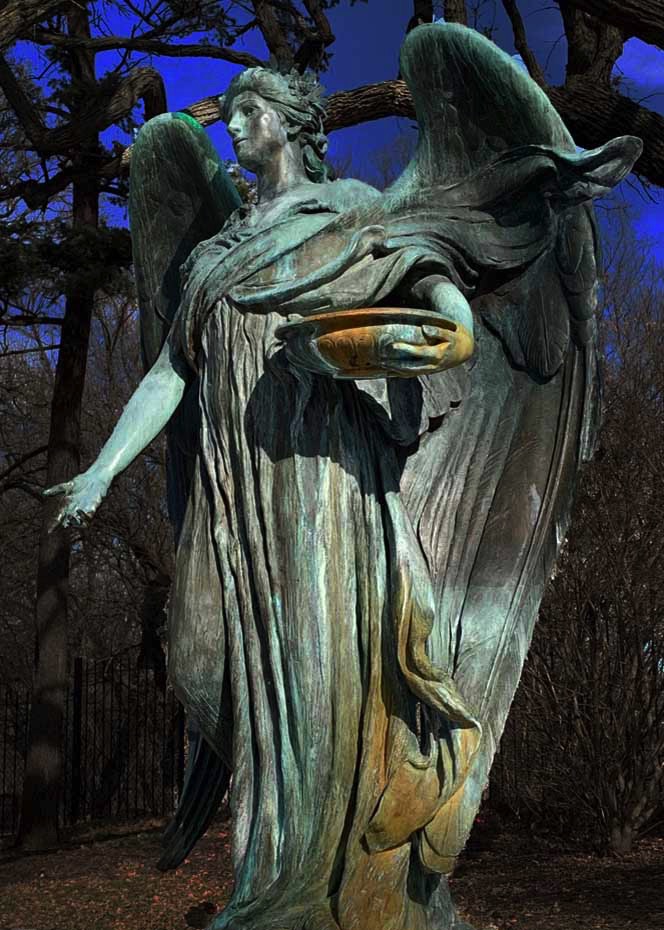
and above the entrance a statue of Justinia bearing a sword and not
wearing a blind-fold.
In August 1885 the county accept Wickham Brothers bid of $136,000
to construct the courthouse with much of the masonry work done by
Stephen Robinson and the decorative features by K. Norling.
The courthouse was finally dedicated in March 1888 and was
reputed to have cost just over $180,000 to finish.
Chairman Underwood of the Pottawattamie County Board of
Supervisors noted that although construction costs had escalated the
work was "done as good and as cheap as competition would
admit." Colonel D.B. Dalley of Council Bluffs called the building a
"monument" to those "who have watched the interests of
the tax payers in the past" and declared that outside of the State
Capitol in Des Moines the county's new courthouse was the "finest
in the State of Iowa." The
Pottawattamie County Bar Association hosted an elegant six-course
banquet held in the south court room to celebrate the buildings opening.
Dealing with the costs of maintenance and modernization of the
Courthouse were left to later county boards.
An elevator was finally installed in 1947, 61 years after the
shaft had been built for it, although one county official labeled the
building a "disgrace and the clock tower that seemed to sway more
with every breeze was removed in 1950.
A one-ton air conditioner was installed in the County Recorder's
office in 1956 and in 1961 county officials had the interior walnut
woodwork painted institutional green. Proposals to construct a new courthouse were rejected in
1962, as was a later plan to build a combined courthouse, jail, city
hall, and police station. By
the end of 1972 county government was sinking to new lows as the
courthouse's foundation appeared to drop at a rate of a quarter-inch to
two inches a month. Funds
were expended to stabilize the foundation the next year but precarious
situation forced the removal of Justinia in February 1974 before she
fell from her perch to the sidewalk below.
In August 1973 almost 80% of county voters approved a 2.5 million
dollar bond issue to construct the present courthouse along with 4.5
million dollars from the federal government.
Designed by architects Hollis and Miller of Overland Park,
Kansas, construction of the five-story building began in January 1975.
In September 1977, a portion of the old courthouse removed by
lawyer Dudley Gray and rebuilt along Crenshaw Avenue in Torrance,
California as the four-story Iowa Courthouse Building.
The remainder of the 1888 structure was demolished a month later.
|
|